QUANTITATIVE IMAGING
Learning from
imaging phenotypes.
Quantitative image descriptors and structured biomedical data support machine learning across research questions and cohort sizes.
AN INDEPENDENT RESEARCH INITIATIVE
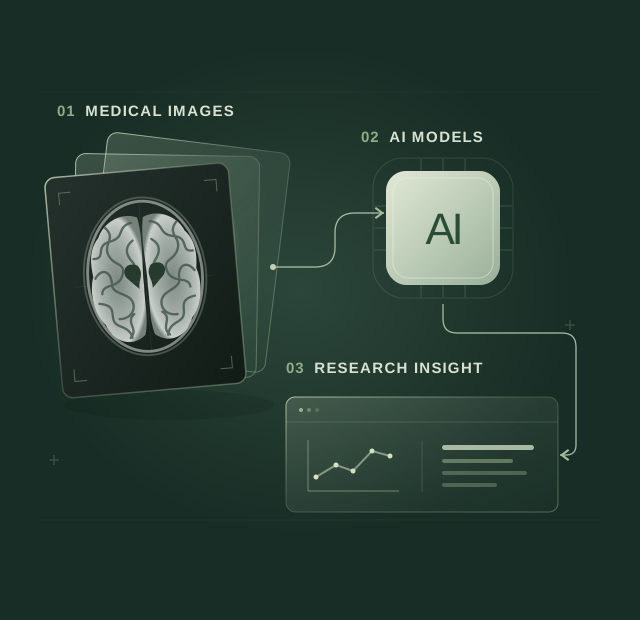
Connecting medical images, biomedical data and artificial intelligence to answer meaningful research questions.
From quantitative imaging to multimodal AI.
Built around the question. Grounded in the data.
01 / RESEARCH
Different datasets call for different approaches. We connect quantitative imaging, computer vision and multimodal learning across three research themes.
QUANTITATIVE IMAGING
Quantitative image descriptors and structured biomedical data support machine learning across research questions and cohort sizes.
MEDICAL COMPUTER VISION
Image-based methods for segmentation, classification and representation learning, from 2D acquisitions to 3D volumes.
MULTIMODAL INTELLIGENCE
Exploring how medical images, structured phenotypes and clinical text can inform shared representations and image-to-text research.
Research directions
Exploring artificial intelligence for brain imaging, with an interest in understanding complex patterns and supporting reproducible neuroscience research.
Exploring segmentation, learned representations and fusion across imaging modalities. Study design and model selection are tailored to each dataset and research question.
Exploring relationships between medical images and clinical text through multimodal representations, image-to-text generation and research-oriented reasoning.
02 / OUR APPROACH
A connected workflow, with quality, validation and reproducibility considered at every stage.
01 / PREPARE
Review cohort structure and acquisition quality, define the target task, and establish modality-specific preprocessing.
02 / REPRESENT
Build quantitative image descriptors or learn representations directly from images, according to the needs of the study.
03 / MODEL
Develop tabular, image-based or multimodal models according to sample size, available labels and the intended research outcome.
04 / VALIDATE & INTERPRET
Evaluate generalisation with appropriate cross-validation, centre-aware testing and independent data where available.
Transparent methods. Documented experiments. Reproducible analysis.
THE PRINCIPLE THROUGHOUT03 / COLLABORATE
Have imaging data and a question worth exploring? Let’s discuss how computational imaging and AI could help.
Selected academic projects may receive support at no cost, subject to scope, feasibility and available capacity.
hello@leoimagelab.onlineTell us the modality, cohort size, research goal and available outcomes.
We discuss scientific scope, feasibility, ethics and data-use requirements.
Agree on a workflow, validation strategy and research outputs together.
Start with a project summary. Please do not email identifiable patient data.
04 / ABOUT THE LAB
Leo Image Lab is an independent research initiative focused on artificial intelligence for medical imaging and multimodal biomedical data.
Our aim is to connect useful methods with meaningful scientific questions — through thoughtful study design, transparent evaluation and collaborative research.